

Why Every Indian Business Should Sell on Amazon, Flipkart & Meesho in 2026 | Rcosource

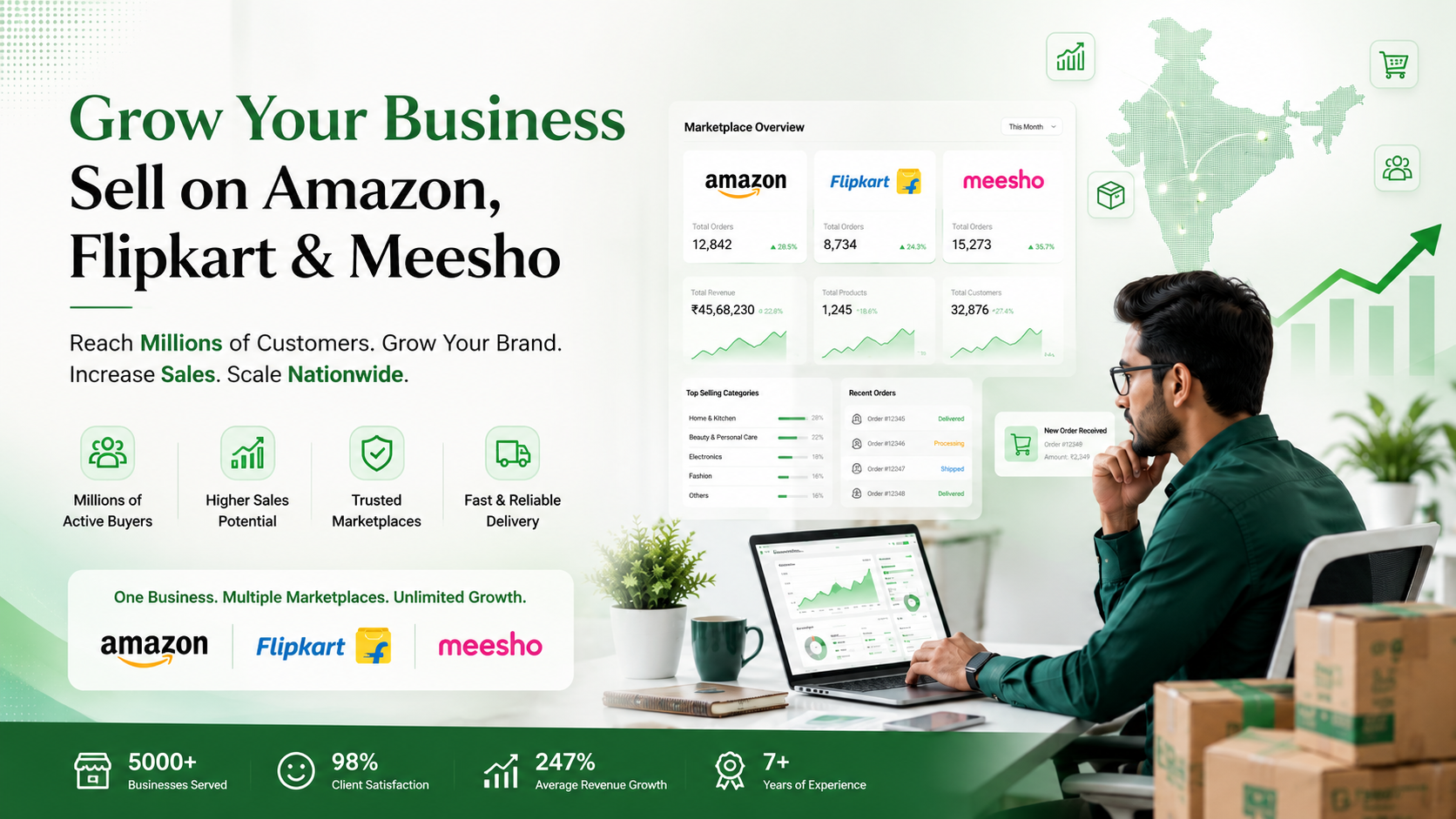
Your Customers Have Already Moved Online. Has Your Business?
A straight-up look at why Amazon, Flipkart and Meesho aren't a "someday" plan anymore for Indian sellers, what genuinely drives sales on these platforms, and the quiet listing mistakes that cost businesses orders they never even see.
Six out of ten new online shoppers in India today are from tier 2 and tier 3 cities
Not Mumbai. Not Delhi. Cities like Indore, Surat, Coimbatore and Patna. If your products aren't listed where these buyers are already searching, somebody else in your category is getting that order instead of you.
Walk through any wholesale market in Indore on a weekday afternoon and you'll notice it without even looking for it — shopkeepers checking their Amazon or Flipkart seller app between customers. Not because it's trendy. Because that's genuinely where a growing share of their orders is now coming from.
Online selling in India stopped being a "should we?" question a while back. The market is on track to move somewhere between $170 and $200 billion in gross merchandise value by the end of the decade, and close to 300 million Indians are already buying online — a number that keeps climbing every festive season, pulled up largely by smaller cities that were barely on anyone's radar five years ago. The question left for most businesses isn't whether to sell online. It's whether they're doing it well enough to actually win once they're there.
01The Shift Already Happened — Most Sellers Just Haven't Caught Up
Here's the part that's easy to miss: your customer's buying behaviour has already changed, whether or not your business has adjusted for it. Payments are the clearest proof. UPI alone now accounts for the majority of online transactions by volume in India, and cash-on-delivery, once the default, is steadily shrinking as more first-time buyers get comfortable paying digitally upfront. Shopping itself has gone mobile-first — most orders on Amazon, Flipkart and Meesho now happen from a phone, not a laptop. And the buyer base has widened too: women shoppers now make up well over a third of all online buyers, driving strong growth in fashion, beauty, home décor and health categories.
None of this is a prediction about the future. It's already the present. A business that's still treating online selling as a side experiment is competing against sellers who treated it as the main channel two years ago.
02Why Amazon, Flipkart And Meesho — Instead Of Just A Website
A lot of business owners assume the "proper" way to sell online is to build a slick website first. In practice, that's usually the slower and more expensive path. A new website starts with zero visitors and zero trust — you have to pay, in time or ad spend, to get every single visitor to even discover you exist. A marketplace listing starts with the opposite problem solved for you: buyers are already there, already searching, already comfortable entering their card or UPI PIN on that platform.
That's really the entire case for marketplaces in one line — you're not creating demand from scratch, you're plugging into demand that already exists. Add to that the fact that Amazon and Flipkart handle a large chunk of the logistics and payment collection for you through their fulfilment programs, and the actual cost of getting your first hundred orders drops dramatically compared to running a standalone D2C brand.
Amazon
The strongest buyer trust for warranty-backed and premium categories. Fulfilment by Amazon takes storage, packing and delivery off your hands, and its reach extends beyond India if you ever want to go global.
Best for: Electronics, health, premium & branded goodsFlipkart
Still the deepest homegrown reach into Indian households, especially outside metros. Big Billion Days alone can move more volume in a week than most sellers see across several regular months.
Best for: Fashion, mobiles, home & lifestyleMeesho
Low seller fees and a massive reseller network make it the fastest on-ramp for new and price-sensitive sellers, particularly strong with tier 2 and tier 3 buyers looking for value.
Best for: Fashion, home essentials, value pricingMost sellers don't lose because the market is too crowded. They lose because their listing was never actually built to be found in the first place.
03The Benefits That Actually Move The Needle
"More sales" is the obvious answer, but it's worth breaking down what's really driving that, because it changes how seriously you treat your listings:
- Built-in discovery — buyers who are already actively searching for your category, not cold traffic you have to earn
- Trust that transfers from the platform to your listing, so a first-time buyer takes a chance on you faster
- Access to concentrated festive-sale volume — Big Billion Days, Great Indian Festival and similar events
- Fulfilment and delivery infrastructure you don't have to build or fund yourself
- Real-time sales and keyword data telling you exactly what to stock more of, and what to drop
- A far lower starting cost than building a full standalone D2C brand from the ground up
04Where Most Sellers Quietly Lose Money
Here's what usually surprises business owners: underperformance on Amazon or Flipkart is rarely a demand problem. It's a listing problem, and it's invisible unless you know exactly what to check.
Generic titles with no real search terms mean the listing never shows up when a buyer actually searches.
Low-quality or non-compliant images quietly kill conversion even when the listing gets clicks.
Wrong category placement or missing backend keywords keeps a perfectly good product buried on page four.
Add incomplete A+ content, missing variation grouping, or small compliance errors that get a listing suppressed entirely, and it becomes clear why two sellers with the exact same product can post very different sales numbers.
05What It Actually Takes To Get This Right
Doing this properly means real keyword research before a single word is written, content built around what buyers actually type into the search bar, images that meet each platform's technical specs, A+ or Enhanced Brand Content that builds trust once someone lands on the page, correct parent-child variation setup, and then ongoing tracking so the listing keeps improving instead of quietly decaying as competitors catch up.
That's genuinely a full-time job, and it's rarely the job a founder or a small team has the bandwidth for on top of running the actual business. This is exactly the gap our team at Rcosource spends its day closing for sellers, working out of our office here in Indore — everything from keyword-driven listing copy and Amazon A+ Content to bulk catalog uploads and ongoing listing optimization, across categories ranging from FMCG to furniture to electronics. As an Amazon SPN Certified Partner, we build listings the way the platform's own guidelines expect them to be built — not around shortcuts that get flagged later.
06Before You List Your First Product
- GST registration in place — required for most categories on all three platforms
- Brand registry sorted, if you're selling under your own brand name
- Correct category and HSN code confirmed before your first upload
- Product images shot to each platform's actual technical specification
- A clear return and warranty policy defined upfront, not figured out after the first complaint
- A simple inventory tracking process, so you're never caught overselling stock you don't have
Ready To Put Your Products In Front Of Buyers Who Are Already Looking?
Selling online works. Selling online well is what separates sellers who scale past their first few hundred orders from sellers who quietly plateau. Let's talk about what your listings actually need.
Frequently Asked Questions
Quick answers to what sellers usually ask us first.
Yes — seller competition has grown, but buyer demand is growing faster, especially outside metros. The bar for a good listing is higher now, which is exactly why listing quality decides who wins, not just who joined first.
Most sellers do better starting with one platform that fits their category and price point, proving the listing actually works, then expanding once the process is repeatable. Running all three from day one usually just means three half-optimized listings instead of one strong one.
You'll need GST registration for most product categories, along with a valid PAN and bank account. A private limited company isn't mandatory — proprietorships and partnerships with GST registration can sell too.
Ranking comes down to keyword relevance in the title and backend search terms, image and content quality, price competitiveness, review volume, and how consistently the listing converts once someone clicks it. Identical products can rank very differently purely because of listing quality.
A well-optimized listing usually starts picking up visibility within the first couple of weeks. Consistent sales volume tends to build over 4 to 8 weeks as reviews accumulate and the platform's algorithm gathers enough performance data to rank it properly.