

Top 10 Mistakes Small Businesses Make When Selling Online (And How to Avoid Them in 2026)

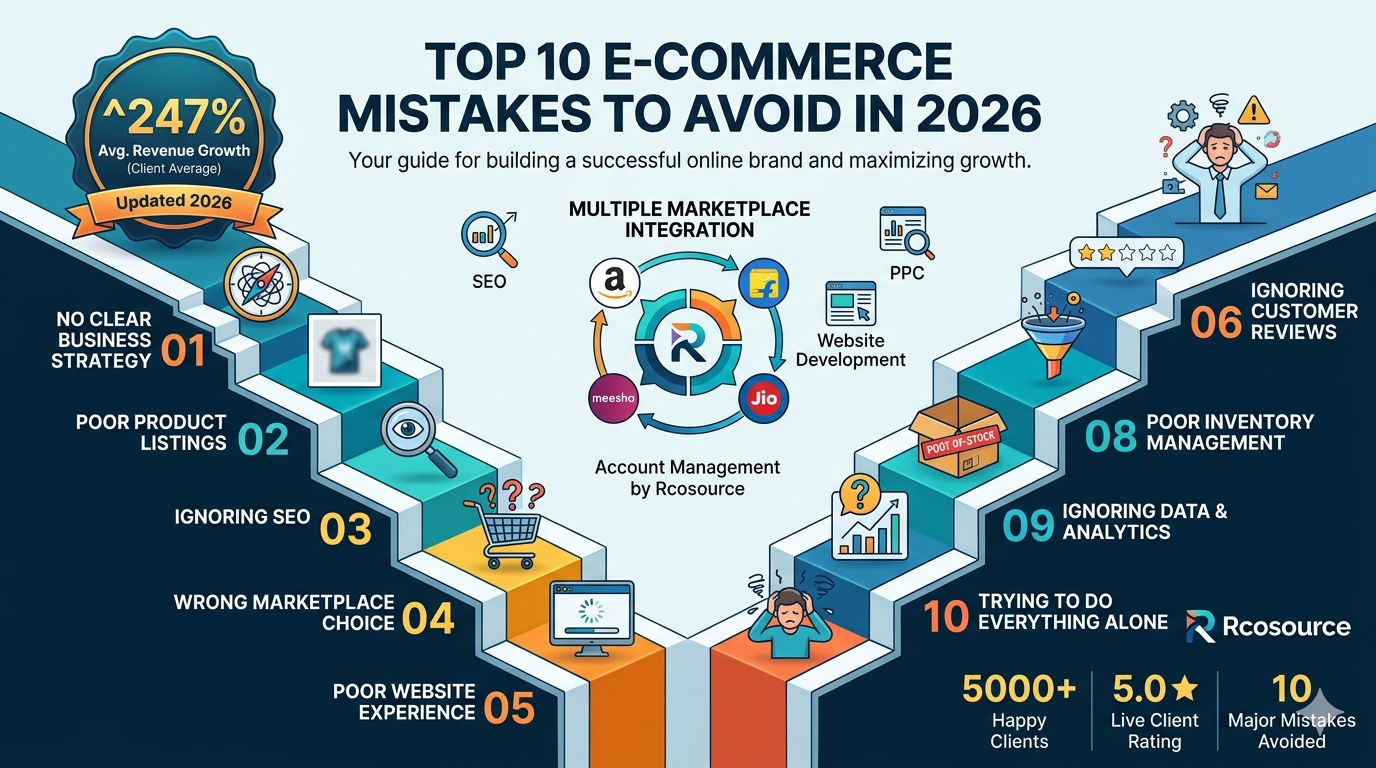
Top 10 Mistakes Small Businesses Make When Selling Online
Most sellers don't fail because the market is too competitive — they fail because of avoidable mistakes in strategy, listings, and operations. Here's exactly what's costing you sales in 2026, and how to fix each one.
Most sellers are making at least 3 of these mistakes right now
From unclear strategy to neglected analytics — each mistake below quietly chips away at visibility, conversions, and repeat customers. Tap any card to see the fix.
Selling online has never been easier — but succeeding online has never been more competitive. Every day, thousands of small businesses launch products on marketplaces like Amazon, Flipkart, Meesho, and Jiomart, expecting quick success. Most struggle instead, not because the opportunity isn't real, but because of mistakes that are completely avoidable.
Building a successful online business takes more than listing products. It takes the right strategy, optimized listings, a professional website, sharp digital marketing, and continuous marketplace optimization — all working together. Below are the ten mistakes we see most often, and exactly what to do instead.
The 10 Mistakes — and Their Fixes
Tap any mistake to expand it. Left side is the problem, right side is exactly what to do about it.
Selling Without a Clear Business Strategy
- Seller accounts created and products uploaded with no defined goals
- Unclear target audience leads to ineffective marketing
- Low conversion rates and wasted ad budget follow naturally
- Define your ideal customer and product categories upfront
- Set a clear pricing strategy and realistic sales goals
- Build a marketing plan tied to an actual growth roadmap
Poor Product Listings
- Low-quality images and short, vague descriptions
- Missing specifications and confusing, keyword-poor titles
- Write keyword-rich titles paired with high-resolution images
- Add detailed descriptions, clear benefits, and an FAQ section
Ignoring SEO
- Relying only on paid ads while ignoring organic search
- Products become harder to find, raising marketing costs
- Invest in keyword research and product page optimization
- Cover meta titles, meta descriptions, and technical SEO
Choosing the Wrong Marketplace
- Uploading every product to every platform without research
- Ignoring that Amazon, Flipkart, Meesho, and Jiomart serve different audiences
- Research customer demographics, demand, and fees per platform
- Pick marketplaces that match your product and pricing tier
Poor Website Experience
- Slow load times and a site that isn't mobile-friendly
- Confusing navigation that fails to build customer trust
- Build with responsive design, fast load speed, and SSL security
- Keep navigation simple with clear product categories
Ignoring Customer Reviews
- Not requesting reviews or responding to feedback
- Leaving complaints unresolved, which dents future sales
- Actively encourage customers to leave reviews
- Respond professionally to both positive and negative feedback
Weak Digital Marketing
- Publishing products and assuming customers will simply find them
- Even excellent products stay invisible without promotion
- Combine SEO, Google Ads, social media, and email marketing
- Use marketplace advertising for consistent customer acquisition
Poor Inventory Management
- Customers ordering products that are actually unavailable
- Cancellations, negative reviews, and falling marketplace rank
- Use systems that track stock and sync marketplace inventory
- Prevent overselling and forecast demand ahead of time
Ignoring Data and Analytics
- Decisions made on assumptions instead of real numbers
- No visibility into best-sellers, traffic sources, or ROI
- Monitor website analytics and marketplace reports regularly
- Track sales trends and advertising performance over time
Trying to Do Everything Alone
- One person handling website, listings, SEO, design, ads, and support
- Growth slows because nothing gets the attention it needs
- Partner with experienced professionals for the technical work
- Stay focused on products, customers, and expansion
Best Practices for Online Business Success
Fix all ten mistakes and these ten habits are what you're left with.
How Rcosource Helps You Avoid All Ten
Complete e-commerce solutions so none of these mistakes ever become your problem.
Website & Listings
E-commerce website development, Shopify and WooCommerce builds, and product listing optimization that converts.
SEO & Marketing
Search engine optimization paired with full digital marketing — Google Ads, social, email, and content.
Marketplace Management
Amazon seller account management, Flipkart support, and Meesho marketplace management, fully handled.
Frequently Asked Questions
The biggest mistake is selling without a clear strategy, which often leads to poor visibility, low conversions, and inconsistent sales.
Optimized product listings improve search rankings, increase customer trust, and boost conversion rates across marketplaces.
SEO increases organic traffic, improves search visibility, reduces advertising costs, and supports long-term business growth.
Yes. Selling on platforms like Amazon, Flipkart, Meesho, and your own website helps diversify revenue and reach a larger customer base.
Professional marketplace management helps optimize listings, maintain account health, improve product rankings, and maximize sales performance.
Ready to Fix What's Costing You Sales?
From strategy and listings to SEO, marketing, and full marketplace management — Rcosource helps you avoid every mistake on this list and build a brand that grows.
Conclusion
Selling online offers incredible opportunities, but success depends on avoiding the mistakes that prevent growth. From optimized product listings and SEO to a better customer experience and professional marketplace operations, every fix on this list compounds into real, lasting results.
Businesses that focus on strategy instead of shortcuts build stronger brands, attract more customers, and generate consistent sales. Whether you're just starting out or scaling an existing store, avoiding these ten mistakes is how you stay competitive in 2026 and beyond.